napkinthe engineering sketchbook

A visual research report · 1480s → 1986

Engineering sketches
become living studies.

A drawing holds a theory of how something works. A Napkin study adds the quantities, assumptions and checks needed to test one part of that theory.

Explore fourteen artifacts, then follow a concrete chat workflow for each. The models use modern illustrative inputs: they answer sizing questions without claiming to reconstruct the original machines.

Explore the drawings ↓
14 source artifacts70 chat steps14 checked models
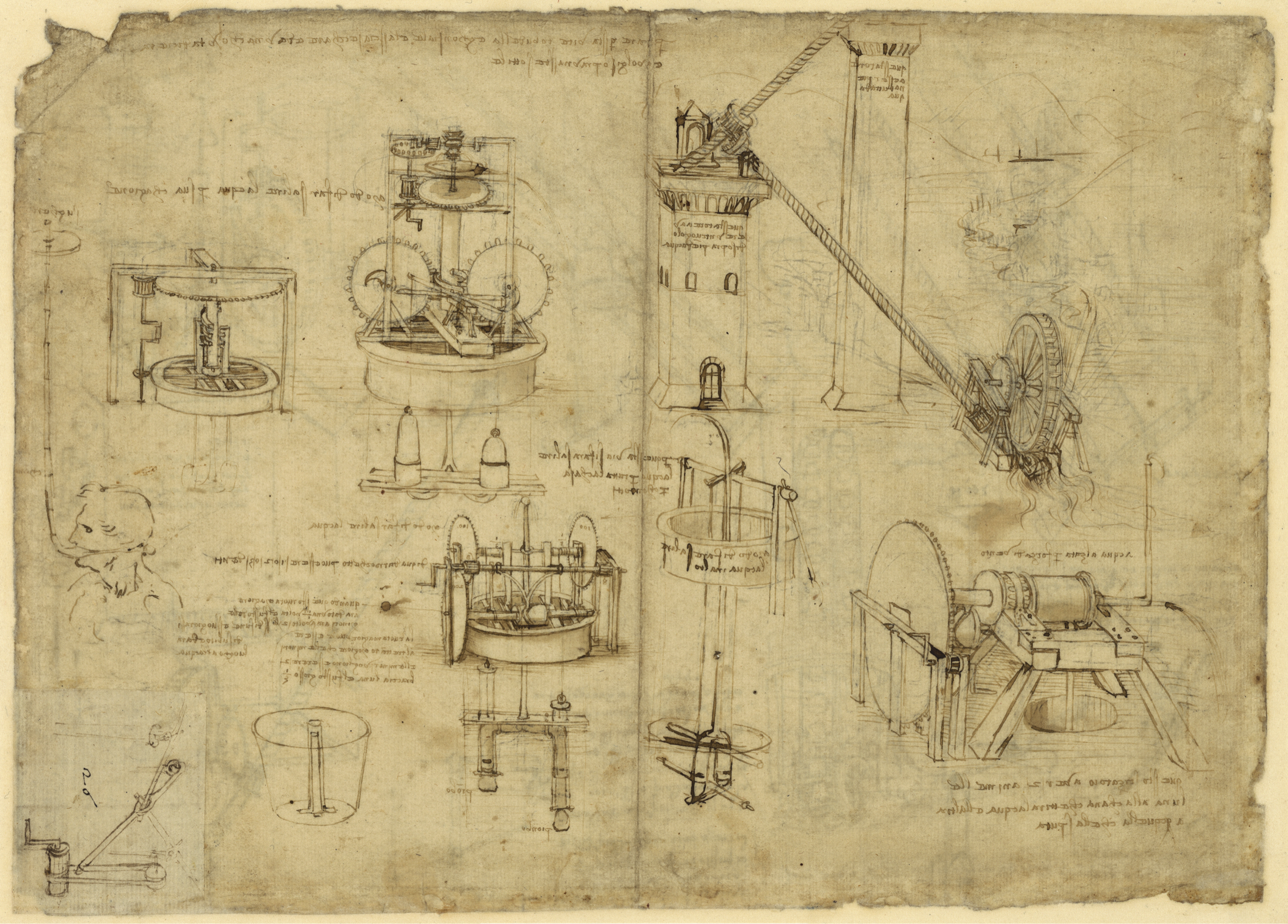
Leonardo’s water-machine studies in the Codex Atlanticus
Leonardo da Vinci · water mechanisms · c. 1480–1482
Codex Atlanticus f. 1069r · Biblioteca Ambrosiana ↗

What counts as a “napkin”?

Here, “napkin” means a compact piece of engineering reasoning. This curated archive contains one manuscript, one laboratory notebook, one later published illustration and eleven patent drawings. It is a lineage of ways to reason, rather than a complete history of invention. Dates below belong to the visible artifacts; patent dates are grants. Earlier design dates appear separately.

01 · The archive

Follow the engineering thought.

Select a drawing to see its source,
decision question and five chat exchanges.

14 drawings

Biblioteca Ambrosiana · c. 1480–1482
Manuscript · Source record ↗

01 / 14 · Water + motion

Water-raising machines

Codex Atlanticus, folio 1069r. Pen, ink and wash studies of water-raising mechanisms, screw forms and a siphon bucket. This sheet records several mechanisms rather than one finished machine. [Source]

What the drawing teaches

A mechanism drawing can become a power budget before its gears become detailed geometry.

The contemporary study

How much shaft power lifts a chosen water flow?

Flow, lift height, efficiency → shaft power → drive check.

Scope boundary. A steady hydraulic power budget; no gear motion, cavitation or pump curve. Efficiency is assumed.

Historical idea → contemporary chat workflow

Five exchanges to make it testable.

The prompts below reinterpret the engineering question. They are not reconstructed historical conversations.

  1. 01

    Preserve the source and the question

    Create a Napkin study called “Water-raising machines — illustrative sizing”. Keep the attached historical drawing as a source reference. Preserve pump topology and the water-lift intention; never infer dimensions from the folio. The engineering question is: How much shaft power lifts a chosen water flow? Do not invent historical dimensions or ratings.

    napkin_capabilities → napkin_create → napkin_snapshot; optional napkin_edit set-drawing for source metadata.

  2. 02

    Separate facts from assumptions

    List what the source supports, what is uncertain, and what must be measured. For this first pass use clearly labeled modern illustrative values, never historical measurements. Model this chain: Flow, lift height, efficiency → shaft power → drive check.

    Input quantities carry units, ranges, tolerances and assumption strings. Derived quantities retain equations.

  3. 03

    Encode the compact sketch model

    Use napkin_sketch to apply the following text to the study with the current expectedRevision and prefix "davinci". Explain pumpPower and open the study. These numbers are illustrative assumptions.

    napkin_snapshot → napkin_sketch → napkin_explain → napkin_open; scalar code below.

  4. 04

    Ask a decision question

    Does required power exceed 200 W at 5 L/s? Which input dominates? Run the named scalar sweep in analytic mode and use napkin_analyze sensitivity for pumpPower versus flow. Report units, the check outcomes and assumptions; keep baseline inputs unchanged.

    napkin_run for the sweep; napkin_analyze kind=sensitivity using returned quantity refs.

  5. 05

    Compare against evidence and revise

    Measure flow, lift and input torque/speed on a bench pump; compare power and losses. Attach test or external-analysis evidence as source references. Compare like-for-like conditions, explain any discrepancy, and revise only inputs justified by that evidence. Report what the model still cannot answer.

    napkin_explain → evidence reference via napkin_edit → revision-checked input update → rerun; prior runs become stale.

Step 03 · paste alongside the prompt

A runnable sketch model

Every number is a modern illustrative assumption, not a historical reconstruction.

= defines inputs; := defines derived quantities; check states the decision threshold; sweep changes one input across scalar cases.

130.8 WpumpPower

Verified with the repository’s parser and analytic evaluator.
Baseline checks: passed · three-case sweep checks: failed.
A failed check is a design result, not a syntax failure.

rho = 1000 kg/m^3 "Illustrative water density"
g = 9.81 m/s^2
flow = 0.002 m^3/s in 0.001..0.005 ± 10% "Modern illustrative flow"
head = 3 m "Assumed lift height"
efficiency = 0.45 "Assumed overall efficiency"
pumpPower := rho*g*flow*head/efficiency [W]
check drive: pumpPower <= 200 W
sweep Flow: flow = 0.001, 0.002, 0.005 m^3/s

02 · One discipline across fourteen domains

Keep the source, drawing and model distinct.

A source image is evidence.

The scalar sketch text creates analytical records; it does not create a drawing of the historical mechanism. Add coarse linked geometry separately with napkin_edit when actual dimensions are available. The image tells you what was depicted. It does not supply unknown dimensions, performance curves or test results. Store its URL and description as a source reference. If a linked Napkin drawing is added, its dimensions and transforms must come from explicit model bindings.

An equation is a claim you can inspect.

These examples use supported unit-aware scalar expressions, checks, sweeps and sensitivity. They do not require recognizing a scanned patent as geometry. A schematic can explain topology while the analytical quantities remain explicit.

Give every input a provenance.

Source-supported: what the cited artifact actually establishes. Measured: a value with test conditions, instrument and uncertainty. Assumed: an illustrative value awaiting evidence. Derived: an equation with named inputs. Every numeric input in this report belongs to the assumed category, including constants adopted for the exercise.

A sweep is a question, not a baseline edit.

Run the saved scenario and inspect all cases. A failed threshold at one case is useful information. Sensitivity reports a local numerical derivative; it does not prove validity outside the model’s stated assumptions.

Discovernapkin_capabilitiesCreate + inspectnapkin_create → napkin_snapshotEncode + explainnapkin_sketch → napkin_explain → napkin_openAsk + verifynapkin_run → napkin_analyzeEvidence + revisionnapkin_edit → snapshot → rerun

Revision discipline. Read the current snapshot before a mutation and pass its revision as expectedRevision. Use returned study, scenario and quantity references; do not invent IDs. Reuse the same sketch prefix for an update, and inspect any obsolete entities rather than assuming they disappear. After an edit, previous run results refer to an older revision and must be rerun. Discover the installed capabilities first: a cached plugin may lag behind this repository.

Technical basis: package guide, sizing analysis, local plugin guide. Local reference snapshots accompany this report. The package guide contains a legacy 0.5.0 version label; executable examples were checked against this repository’s 0.6.1 source. Full numerical validation traces retain all fourteen runs.

A small consequence you can change

Lift rises with speed squared.

For the Wright-inspired study, fixed illustrative inputs are density 1.225 kg/m³, area 30 m², lift coefficient 0.8 and mass 300 kg. Move only airspeed. This steady lift budget does not assess wing-warping control or stall.

Standalone report calculator · not connected to Napkin MCP.

Idealized lift2,117 NWeight2,943 N

✕ Lift is below assumed weight

L = ½ ρ v² S CL · crossing ≈ 14.15 m/s

03 · Build a useful first study

Begin where evidence is easiest to collect.

01 · Start with a bench check

Water power or wheel resolution

Leonardo’s power budget and Engelbart’s wheel geometry use directly measurable inputs. Change flow or diameter, inspect one output and compare it with a bench measurement. You can close the evidence loop quickly.

Open water-power study ↗
02 · Add empirical behavior

Resistance, pressure loss or shear

Bell, Edison, Dyson and de Mestral bring in values that vary with operating conditions. Keep the assumed constant visible; then replace it with a measurement at the matching operating point.

Open fan-power study ↗
03 · Expand the model boundary

Control, fields, cycles or structure

Wright, Tesla, Whittle, Goddard and Fuller expose what a scalar model leaves unresolved. Establish a sizing baseline, then take stability, field behavior, thermal matching or structural integrity to specialist analysis and tests.

Open flight study ↗

The best first study has one decision, a short chain of equations and a measurement that could prove an assumption wrong. The historical drawing supplies the question. Your evidence makes the contemporary model useful.