HISTORICAL DRAWING · 1888
Rotating-field motor
How do assumed slip and mechanical output set shaft speed and torque?
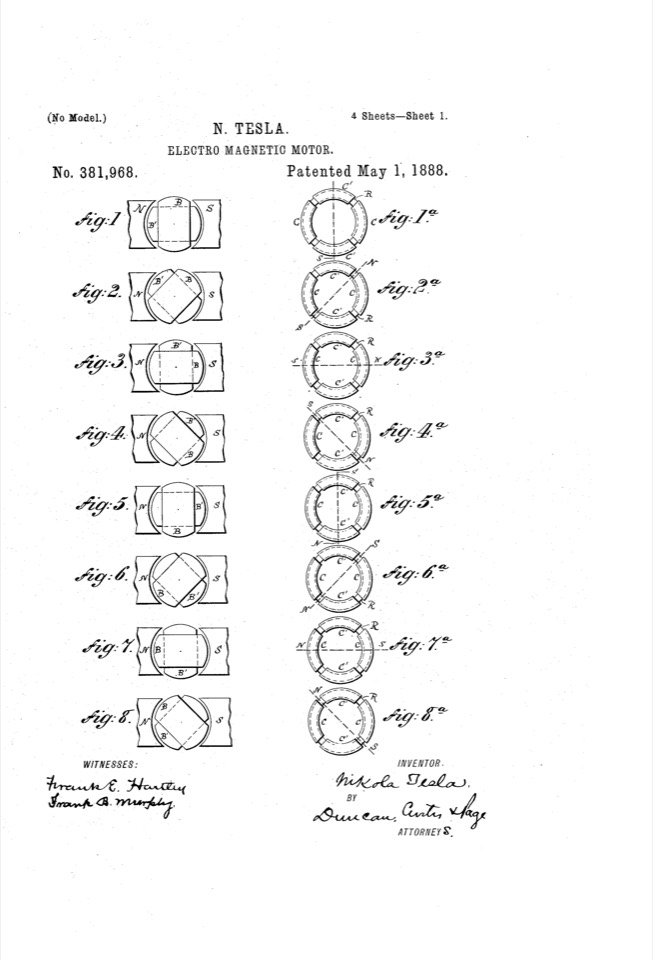
A contemporary sketch model
Every number below is a modern illustrative assumption. The historical drawing supplies a question; the source model is an exercise in reasoning about it.
frequency = 50 Hz "Illustrative supply frequency"
poles = 4 "Assumed total magnetic poles"
slip = 0.04 in 0.01..0.1 "Assumed motoring slip"
power = 500 W "Assumed mechanical shaft output"
syncOmega := 4*pi*frequency/poles [rad/s]
shaftOmega := syncOmega*(1-slip) [rad/s]
torque := power/shaftOmega [N*m]
check torqueBudget: torque <= 4 N*m
sweep Slip: slip = 0.01, 0.04, 0.1
Model limits
Slip and output power are independent assumptions; no electromagnetic field solve, starting torque or torque-slip prediction.
Explore it with your agent
Create a Study, inspect the installed capabilities, and use this source as a starting point. Ask the agent to explain the equations and assumptions, then replace illustrative inputs with measured evidence for your own design.
This example includes a scalar sweep. Use napkin_sketch to add the model and napkin_run to inspect the sweep; the source editor’s scalar comparison view is for simple scenarios.